Cluster Information
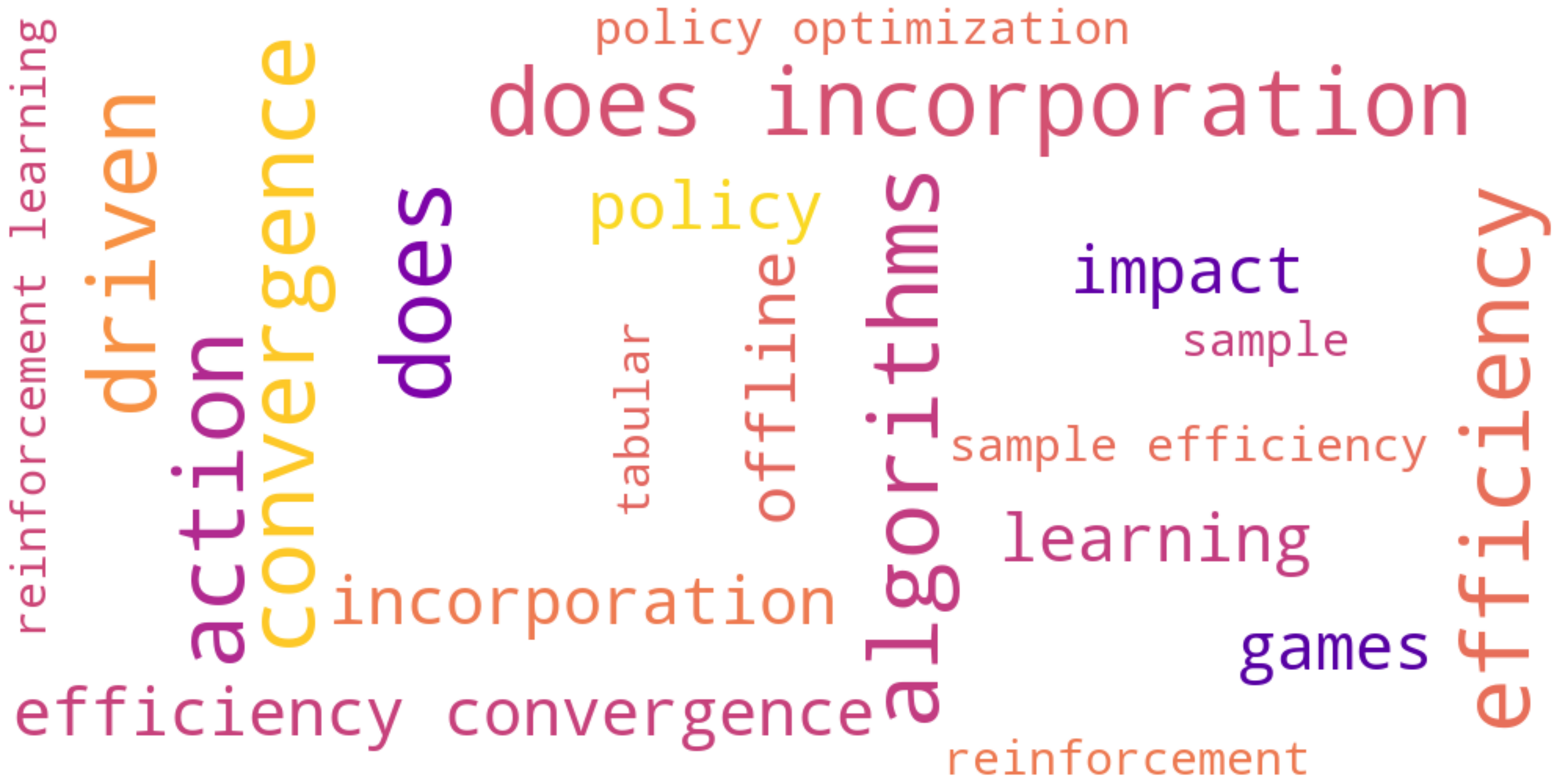
Top Keywords
Offline RL Integration Effects
Cluster 5 • Research Topic Report
Generated: May 07, 2020
Quick Summary
This research addresses the challenge of improving sample efficiency, convergence rate, and policy optimality in online reinforcement learning agents by integrating offline reinforcement learning techniques, such as dataset distillation and automated specification refinement, particularly in complex control tasks and stochastic environments.
The problem is PARTIALLY SOLVED, as studies demonstrate enhanced performance through strategic offline data usage and adaptive policy learning, but gaps remain in understanding the direct effects of dataset distillation and specification refinement, as well as their scalability to high-dimensional tasks.
Future research should focus on explicitly evaluating these techniques and exploring their application to more complex environments to fully realize their potential benefits..
Research Question
What are the impacts of integrating offline reinforcement learning techniques, such as dataset distillation and automated specification refinement, on the sample efficiency, convergence rate, and policy optimality of online reinforcement learning agents in complex control tasks and stochastic environments?
Referenced Papers
Click on any paper title to view it on Semantic Scholar.
-
1.Policy Expansion for Bridging Offline-to-Online Reinforcement Learning2023 — International Conference on Learning RepresentationsID: 7f270c9b098727675c9d8b893e362b561d61f27e
-
2.A Trajectory Perspective on the Role of Data Sampling Techniques in Offline Reinforcement Learning2024 — Adaptive Agents and Multi-Agent SystemsID: 14094bc5c16b213a9bae7d111e26d929713e8087
-
3.Behavior Regularized Offline Reinforcement Learning2019 — arXiv.orgID: 9be492858863c8c7c24be1ecb75724de5086bd8e
-
4.Efficient Online Reinforcement Learning with Offline Data2023 — International Conference on Machine LearningID: bd38cbbb346a347cb5b60ac4a133b3d73cb44e07
-
5.Efficient Online Reinforcement Learning Fine-Tuning Need Not Retain Offline Data2024 — International Conference on Learning RepresentationsID: c2c0e1ec3e006ebd6533aae98131128dc1358f0d
-
6.Policy Finetuning: Bridging Sample-Efficient Offline and Online Reinforcement Learning2021 — Neural Information Processing SystemsID: d769ca62d90adc7e7869849a421426bdc54a32fb
-
7.Adaptive Policy Learning for Offline-to-Online Reinforcement Learning2023 — AAAI Conference on Artificial IntelligenceID: f6274e6ba614b46d6283c775cfe4565e8ce50bc8